

64. Museum Of Modern Art (NYC)
Updated: Feb 19
Monday, June 19, 2023

Image: Georgia O'Keefe, Sunrise, water color, 1916 Public Domain
I took Metro-North to Manhattan to go to the Museum of Modern Art (MoMA). I left on the 10:13 morning train from Southeast to Grand Central, arriving around 11:49. I had a ticket for entrance to MoMA at 11:30. Southeast is the origin of the train, so it was nearly empty. It filled to capacity, in a short time, with standing room only by the time we reached Grand Central.
A woman of oriental heritage came onto the train in Southeast. She put her luggage up on the rack. A box she was holding under her arm fell to the floor. I reached over to pick it up, but she had it herself quickly. I mentioned the quickness of gravity. She smiled. We talked briefly. I thought she was going to sit across from me, under the luggage rack, as the first two rows of seats face each other. I wanted to talk with her some more. She seemed interesting. But, it seems what she was really interested in was plugging in her phone! She commented on how few plugs there were on trains, as she located one that was available behind a seat adjacent to me, across the aisle. She plugged in her phone, then sat down and put in her ear plugs. Technology. So much for an interesting conversation on the train ride to Manhattan.
I got out the book I am reading lately, Why We Sleep, by Matthew Walker. I read most of the way to NY. Quite informative about what goes in our brains and with our bodies regarding sleep!
There were two pauses in my reading. First, another woman sitting nearby was wearing a t-shirt that said Yellowstone on it. I asked her if she had been there recently. She said no. I asked her if she had ever been to Yellowstone. Again, she said no. I told her I had been there a couple of weeks ago. She smiled and said, “oh.” I got the impression she did not know much about Yellowstone, not where it was located, that it was a national park, nothing. Somehow, she came to be wearing a shirt with Yellowstone written on it. I smiled back and went back to my book.
Second, as we were approaching the station, two guys who were sitting opposite me asked me about Yellowstone. They each had long hair, down past their shoulders. I remember those days, days with my long hair braided in a ponytail down my back. They said they had never been to Yellowstone, and they wanted to go sometime. I told them it blew me away, it was fantastic. We talked a little bit. They were probably around twenty-years old, visiting family here in the area. They were from Wisconsin. They had recently been to Sedona and Grand Canyon. They told me they did some nice hikes around Sedona. I will check out hikes there in the Fall, as I plan to be in the area.
I wished I had started talking with them earlier. Keep that in mind next time you are moved to talk with someone. Do it. Start talking. The little time we talked, they were interesting, which brings me to a question: are most people interesting? What do you think? How do you know?
In the Grand Central terminal, I went to a bagel place, Zaro’ and bought two cinnamon raisin bagels. They were $1.80 each, reasonable for New York I thought. If you wanted butter on it, it was another $1.15, and cream cheese was $3.00 extra!
I walked to Fifth Avenue and strolled up to 53rd Street, where the MoMA is located. I had not realized that I would be walking right by Rockefeller Center and Saint Patrick’s Cathedral. Mom always loved going to those places. I thought of her happiness, it made me smile, but I did not stop in to see those places. I arrived at the museum and used my phone as a ticket to enter after having my backpack inspected. I checked my backpack at the coatroom, so I did not have to carry it around with me. The only thing I carried was my notebook. I took plenty of notes as I walked around, some of which I wrote down of course, but also some others that I made mentally only.
The museum was fantastic. I was blown away by the Georgia O’Keefe exhibit. She had quite a body of work, and her art is so tied to the environment, with New Mexico and parts of the western landscapes and cultures involved.
I was probably more impressed with some of the writing that accompanied the paintings and drawings than with the works themselves. I feel like I want to read a book about her, or maybe by her, if such a book is available.
But, one of the first things seen in the museum is a large movie-theater sized screen displaying a computer-generated image of colors in a variety of shapes. It was about 20 yards wide and 30 yards high. It had an effect such that people just stopped and watched. Not surprisingly, I got more of a kick out of watching the people, how they were mesmerized by the screen, than the screen itself. Lots of people were taking photos or videos with their phones.
There were string-like entities in the changing image on the screen. They were like the “threads” you see in electron micrographs of mitosis, silk-like strands, connecting telomeres. I don’t know what they were connecting to on the screen. It seemed everything had some connection to everything else in some way. Maybe that was an artistic theme? Initially, the colors were mostly shades of black and white, a variety of greys, with a few other light colors occasionally. Some brighter red came forward, which reminded me of cactus in Arizona for some reason, the silk-like strands now seemed to be those needles along the top and sides of barrel cactus. I noted when I returned later there were many additional bright colors. Vibrant.
I have since learned that this is an exhibit, titled Unsupervised, by Refik Anadol. You can read about it here: https://www.moma.org/calendar/exhibitions/5535
Among the screen watchers was a casually dressed woman in blue pants and top with some blue sneakers. She was slim, but not skinny. Tall, maybe 6’. She looked to be in her 50s or 60s. Her hair was a dirty blond brown, tied back, shoulder length. She walked past me. I walked past her a little later, on my way outside to the sculpture garden. I did not think anything of her again, until I was just about to leave …
After watching that screen for a short time, I walked outside into the Sculpture Garden. There were a lot of chairs, mostly unoccupied. Those who were sitting seemed to be busy, reading or talking on their phones or taking pictures. Technology. I did not notice anyone just sitting, just sitting and watching, just kind of being still. There was a bar off to the side. I noted that, of those sitting, it did not appear anyone was partaking in a beverage. It was only about 12:30. I thought about having a beer, but I declined. Maybe later, I said. Later never came, in that regard.
I walked around the perimeter of the outdoor area. It was a beautiful day of mixed sun and clouds. There was a restaurant with outdoor seating off to one side, waiters outfitted in uniforms to suggest a degree of formality. I had looked at menus earlier in the morning, while at home, and things were pricey. But I had my bagels!
One thing I noted about the sculpture garden was that I did not find many sculptures, which was surprising.
I went back inside and found my way to a display of four large box-like paintings. I loved the simplicity. They were large squares, perhaps eight to ten feet on a side. Each was composed of a line of blocks, as if bricks of many colors: blue, orange, red, yellow, green, and purple. The “bricks” were not of uniform size. There did not seem to be any order of color. Each painting had the line of “bricks” running in different directions. In the first instance, they were vertical. The second was horizontal. In the third, there was an angular orientation, running upward left to right, and the last was angular as well, running left to right downward. None of the paintings were identical to the others. For example, if the horizontal painting, #1, was turned 90 degrees, it would not be identical to the vertical painting, #2.
From this area, I went up to the second floor into a photography exhibit in the Tatyana Grosman Gallery. I will start out by saying that I did not have much of a positive impression of any of the photographs or of any of the collections of photographs. I conclude that I just don’t get it. These are probably exceptional photographs by talented artists. Some used special effects, layering portraits with filters and colors: blue-green, green, yellow. It did not impress me favorably. How are these world-class, museum quality photographs? I do not know. I am not sure what makes it so exceptional, museum quality, compared to photographs I take or that I have seem taken by friends. I mean, people walking on the beach, people sitting in their living rooms, kitchens, and gadgets. I can see they probably use high quality equipment and developing schemes, but what makes it so … museum quality? I don’t get it. A series of photographs of wall phones and “message centers” in neighbor’s houses? For real? For some other photography, it seemed they played around with special effects. Did that make it museum quality? Because, the content of the photos were simple portraits. There was nothing exceptional, in my opinion. Creative? Yes, they were creative in the use of special effects.

The photographer for the images above is Karl Ohri, a British-Nigerian artist https://www.moma.org/audio/playlist/332/4415
There was a section of one woman’s work, where she cut photographs up and displayed them in wall shelfing made of sections about one inch deep, with boxes created that fit the cut-up sections of photos.

There were seven different photographer-artist exhibits, and I’m afraid I was not drawn to any of them. Like I said, maybe I just don’t get it.
More about the photography: https://www.moma.org/calendar/exhibitions/5525
But then, I went into the Georgia O’Keefe gallery, which is the reason I went to the museum in the first place. This, I enjoyed. I was energized, excited, kind of blown away by it. It was so many things, inspiring so many thoughts and feelings.
Right from the start, by reading the introduction near the entrance, I realized the exhibit was as much about a state of mind, about a state of Being. That was how I saw it. It was not just about the created works. They were a product of her experience, of her processing life! Each of the headline introductions of the following descriptions hit me, strongly …
To see takes time …

How much time do you have? There are many answers to that question. Here is one of them. Time is artificial. Constructing it depends on the context. It seems to me, Georgia O’Keefe was not in a hurry to create, she did not rush it, yet when she started something, she moved swiftly. A combination of patience, motivation, and energetic application. Are you like that? 😊 I like how she would create a series of drawings or paintings, each one building on the previous, her work reflecting how her mind and spirit were exploring. Exploring life through her art, through her creating …
Of course, I love all the color she infused into much of her work. I love the smooth lines, the sometimes gradual, sometimes abrupt lines of change.
Materials as Language
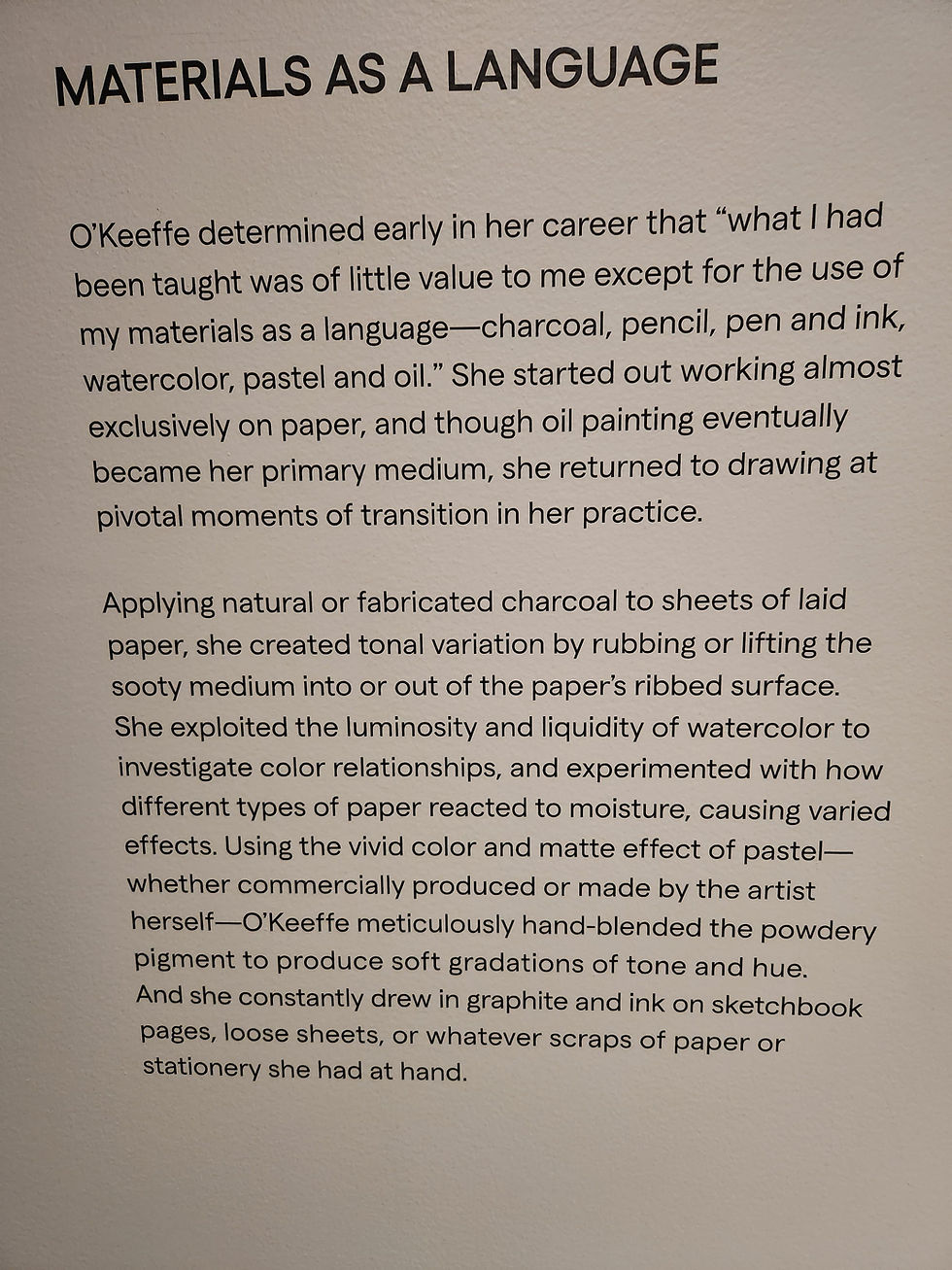
I loved the statement about what she had been taught was of little value to her. I have said something like this many times. For example, what they teach you in preparation for a career as a teacher, or as a librarian, did not prepare me to be a teacher, did not prepare me to be a librarian. The things that became important for me, in order to teach and in order to help students and faculty in the library, were (1) tools that were available. This meant reading materials, websites, and technology. For the most part, I found these tools on my own, and I taught myself to use them, then I shared what I learned with others and everyone; (2) people skills. Being able to communicate about the topics at hand, of course, as well as having the ability to reach people, make them comfortable, create a symbiotic relationship; (3) self-confidence with a can-do and will-do attitude.
In the air, on the ground …

Travel, travel, travel some more. It is fair to say, I can’t get enough travel, but I will keep trying to obtain my fill. I like how it says, “through changes in location and perspective, she encountered new forms.” Travel always has the potential to educate the traveler. Travel brings “new forms” into one’s life. “New forms,” to me, can mean so many things. First of all, you can go to new geographic environments, with different landscapes, different vegetation, and different animals. Those appear first. Then, taking the opportunity to meet new people, you have possible different cultures, exposure to different ideas. This presents the opportunity to reflect, a possible rearrangement of understanding within oneself as all of this combines, as if in a large pot brewing over an oven or campfire. Combining these, one’s “new forms” may become changes internally, mind and heart. One does not have to think about this. When in the right environment, it just happens.
All sorts of things in my head …

One’s brain, mind, feelings, spirit, heart, and soul …. All these things are, in my view, united as one, and they provide a window into and out of oneself. I see all these things inside of me, and I can open up and show them to you. Like right now, I am creating something. What that final something will be, I am not sure. It will be some form of a finished writing product. It is in draft mode, for sure. I am rambling. I feel it, I think it, there is an energy that moves through me.
So really, I loved all her drawings and paintings. But it was the posted descriptions and writing that really impressed me. Her paintings come out of her thoughts and feelings, out of her understanding of time and place. Her experimentation with tools of art integrated with culture and spirit, with landscape and other environmental factors. Mood. Light.
A feeling of bigness …

When I drove out west for the first time, it was in 1984, it was an opening into a new world of unexpected size and dimensions. I refer first to the open space. It first really hit me while driving across Kansas. I had heard from several people that driving across Kansas was a boring thing to do. I did not find that to be the case. I found the landscape exciting. It was so big. So open. One could see across the horizon for miles and miles, unlike anything back in Connecticut. I don’t know if it had to do with this change in landscape, but the sunrise and sunset were spectacular. The Sun appeared so much larger and it had a deeper orange-red color. I thought of this, and other western landscapes, when I read “A Feeling of Bigness.”
Accompanying this physical reality, I felt an opening and growth within me. My mind and spirit seemed to expand. I do not recall what concrete words or feelings I might have used to describe it then, I just know I felt it strongly, as real as the expansion of the physical landscape. It has remained so ever since. Defining cross country by driving west at least 2000 miles, with minimal initial destinations such as Colorado, Montana, and Texas, I have driven cross-country approximately 25 times round-trip. It never gets old. There is always the opportunity to be mesmerized by that bigness of the landscape and spirit.
And while I absolutely have enjoyed driving across Kansas, and similar terrain in The Dakotas, Nebraska, Oklahoma, and Texas, I love the mountains and desert landscape farther west even more.
I was impressed by the revelation of her association with Indigenous people and cultures and the environment. I will look into this more ...
I love the Ram Horn drawing, though her view seems to distort the actual horn. I realize she seemed to want to compile multiple thoughts and feelings into one drawing, and it seemed necessary to distort the horn, as seen below on the left. When I saw this, I thought it was wonderful. But I liked Laura’s drawings of the Ram horns just as much, one example on the right. Laura did a series of horn drawings. I have two of them. Of course, I am not saying Laura is a Georgia O'Keefe. I am not comparing them on any critical artistic standard. I was traveling with Laura when she painted these. That adds significance.
I took several photographs of the paintings on display. I am not sure of the copyright rules on posting them, so for now I am linking to the Georgia O’Keefe Museum in New Mexico, as it has many more works available to see online. I am thinking about going there later in the year: https://collections.okeeffemuseum.org/
After Georgia O’Keefe, I found my way to another section of the Museum that had a large exhibit, titled Chosen Memories, with a variety of artist’s work from Latin America.

One of the artists is Galas Porras-Kim.

More about the Chosen Memories exhibit: https://www.moma.org/calendar/exhibitions/5541
As I was leaving Chosen Memories, about three hours after seeing the woman in blue at the “Unsupervised” exhibit, I come walking towards the escalator, and she walks right in front of me. I immediately thought of my experiences with, and philosophy about, meeting people, how we can be moved into proximity by some unseen source or force.
That’s another story itself. I'll post about it shortly. But, when I asked myself, should I talk with her? I said no. I let her keep walking. As she does, I took the escalator down the flight as planned. I went to the coat check and claimed by backpack. I exited onto 54th Street, and I started walking down the street, towards the rest of my day …
Next Post: 65. About That Meeting ...
Previous Post: 63. Yellowstone National Park, Lower Falls


Comments